A. Philip Randolph, Pioneer of the Civil Rights Movement by Paula F. Pfeffer
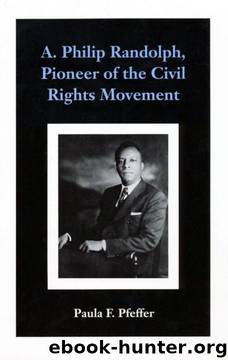
Author:Paula F. Pfeffer
Language: eng
Format: mobi
Published: 2011-08-03T10:47:00+00:00
At the November meeting preceding the second march, Wilkins told Randolph that he wanted a clear statement of purpose before he would authorize the NAACP youth director and youth councils to participate, because he believed that several different statements had obscured the objective of the previous demonstration. Since mass lobbying was "looked upon with horror" by the association's legislative agents in Washington, Wilkins doubted the board would approve NAACP participation if the purpose was to pressure for the school aid bill. To help the civil rights campaign in the Eighty-sixth Congress, however, Wilkins promised to solicit the views of organizations participating in the Leadership Conference for Civil Rights for Randolph's "information and guidance." Wilkins also wanted an estimate of the cost of the march and petition campaign; as the NAACP was entering 1959 with a deficit of at least $85,000, finances were of crucial concern. Mindful of criticism that it did not fully cooperate in the 1958 demonstration, the NAACP pointed out that over io,ooo of its youth and student members had attended the march.'
Always concerned about rival groups, Wilkins became disturbed at a business meeting following the second march when he detected an "unmistakable sentiment ... for some kind of continuing body, not only until the collection of signatures [for the petitions] could he finished, but until `next year."' He wrote Randolph, "The NAACP assisted in the financing of the Youth March with the understanding that it was a loose coalition of groups interested in providing an opportunity for young people of both races to express themselves on school integration." Wilkins emphasized, "We did not intend either last year or this year to finance the setting up of a continuing permanent organization or semi-permanent organization. We have our own permanent and continuing NAACP youth group." Sensing interest in a Washington youth lobby, Wilkins added that the NAACP would not finance it "or any other lobby in Washington" because the association had its own Washington bureau, which had functioned since
Download
This site does not store any files on its server. We only index and link to content provided by other sites. Please contact the content providers to delete copyright contents if any and email us, we'll remove relevant links or contents immediately.
| Anthropology | Archaeology |
| Philosophy | Politics & Government |
| Social Sciences | Sociology |
| Women's Studies |
The Secret History by Donna Tartt(19002)
The Social Justice Warrior Handbook by Lisa De Pasquale(12177)
Thirteen Reasons Why by Jay Asher(8874)
This Is How You Lose Her by Junot Diaz(6857)
Weapons of Math Destruction by Cathy O'Neil(6249)
Zero to One by Peter Thiel(5767)
Beartown by Fredrik Backman(5718)
The Myth of the Strong Leader by Archie Brown(5482)
The Fire Next Time by James Baldwin(5409)
How Democracies Die by Steven Levitsky & Daniel Ziblatt(5200)
Promise Me, Dad by Joe Biden(5130)
Stone's Rules by Roger Stone(5065)
A Higher Loyalty: Truth, Lies, and Leadership by James Comey(4937)
100 Deadly Skills by Clint Emerson(4900)
Rise and Kill First by Ronen Bergman(4761)
Secrecy World by Jake Bernstein(4727)
The David Icke Guide to the Global Conspiracy (and how to end it) by David Icke(4685)
The Farm by Tom Rob Smith(4489)
The Doomsday Machine by Daniel Ellsberg(4474)
